Boulder Restaurants

Boulder Restaurants

The dining scene in Boulder is as exciting and diverse as the community itself. Restaurants in Boulder feature cuisine from around the globe, including MexicanAsianItalian, and of course, contemporary and continental American. From organic, local establishments featuring “farm to table” food to elegant restaurants offering lavish dishes prepared by award-winning chefs, the quest for a memorable meal ends here. Every type of food and every sort of atmosphere can be found on one of the local menus in Boulder, Colorado. Boulder’s residents know how to enjoy themselves. Numerous local breweries, outdoor cafés, and intimate restaurants line the streets in several of Boulder’s unique districts and neighborhoods. Delicious green cuisine and organic delights can be found everywhere: the Pearl Street Mall, Twenty Ninth Street Retail District, and both North and South Boulder. The Hill District, adjacent to the University of Colorado, is another happening area in which to sample Boulder’s lively nightlife scene and check out some of the locally-brewed craft micro beers that Boulder is famous for.

Denver’s 25 Best Restaurants — Five of them are in Boulder
Boulder Creek Winery — Watch a 6-minute video on this award winning winery

Courtesy of www.bouldercoloradousa.com


John Marcotte

720-771-9401

Search all Boulder homes for sale 

 

BH4U

7 Ways to Sip and Savor Boulder

7 Ways to Sip and Savor Boulder


Unique Experiences in Boulder’s Beer, Wine and Spirits Scenes

1. Mix Your Own Cocktail at Salt

Suspect you’ve got mad mixology skills? Anyone can give cocktail-concocting a try at Boulder’s Salt Bistro. Their Cocktail Element menu allows you to mix and match your preferred ingredients. Choose your base spirit, such as tequila or vodka; the herb, spice or fruit you’d like to add for flavor; and the style, such as fizz, ricky or collins. And voilà: your own signature drink.

2. Taste 303 Vodka’s 106-Year-Old Family Recipe

At Boulder Distillery, you’ll notice an old steamer trunk and a plaque explaining that it belonged to the grandfather of local distiller Steve Viezbicke. It arrived from Poland in 1907, and the family vodka recipe, which became the basis for Boulder Distillery’s lauded 303 Vodka, was found tucked inside. Hear the story, taste the samples and enjoy the decidedly laid-back atmosphere at this warehouse distillery.

3. Pedal Your Way to Boulder’s Breweries and Bars on MyHandleBar

Described as “a giant, 16-passenger bar bike with several pedaling seats,” MyHandleBar is similar in concept to renting a limo for a party – except that the limo, in this case, is an open-air, leg-powered, eco-friendly bike that knows all the best bars in town. Not traveling with 15 of your closest friends? MyHandleBar has been known to offer a pay-per-seat pub crawl on Wednesdays. Check the website for details.

4. Soak (and Sip) Up Knowledge at The Bitter Bar

There are lots of lounge-worthy seats at The Bitter Bar, but if you belly right up to the bar, you’ll have a chance to chat with the ultra-knowledgeable, passionate bar staff. Ask how many herbs are in green chartreuse (hint: it’s over 100), how they make their own bitters in-house (hence, the name), or how they choose and source their unique glassware (and why it matters).

5. Sample Civilization’s First Libation at Redstone Meadery

There’s pretty strong evidence that fermented honey was humankind’s first foray into buzz-inducing beverages. You get the feeling the folks atRedstone Meadery would be just fine if humanity had stopped right there. Take a half-hour tour, and sample some delicious varieties of meads (black raspberry!) that will go a long way to convincing you that mead is indeed the nectar of the gods.


6. Go Your Own Way at Boulder Creek Winery

More the DIY type than the group-tour kind of guy or gal? The self-guided tour at Boulder Creek Winery is for you. Enjoy a generous wine tasting and friendly conversation with the tasting room staff for just $5, and then check out the facility, wine barrels, a map of Colorado’s wine grapes and historical information about the winery on a self-guided tour.

7. Sip Exclusive Beers, Right from the Source, at Avery Brewing

When you visit Avery Brewing‘s taproom, you’re bound to feel a tad bit smug that you get to sample several scrumptious suds that can only be had right there, on site. Sure, the masses may have had Avery’s famous White Rascal or Ellie’s Brown Ale, but have they had the malty Wee Turtles Scottish ale or the passion fruit-infused Belgian-style Lilikoi Kepolo? Nope. Just you.

There’s Always More

Find more ways to enjoy Boulder’s libations by checking out the Boulder’s brewery, winery and distillery tour listings.

And Don’t Forget the Food…

Boulder was named America’s Foodiest City by Bon Appétit magazine. Read Boulder’s top chefs’ recommendations on how best to enjoy the wealth of food and drink, as well as fun things to do in Boulder.

Article courtesy of www.bouldercoloradousa.com


John Marcotte

720-771-9401

Search all Boulder homes for sale 


BH4U

Boulder Restaurants

Boulder Restaurants

Boulder might be the top food destination in Colorado. Here’s why…

  • Bon Appetit magazine called Boulder America’s Foodiest Town in 2010.
  • The Wall Street Journal called Boulder the “Best small city for great meals” in November 2009.
  • Bon Appetit wrote “Boulder is officially bursting at it foodie-seams” in June 2007.
  • The Denver Post wrote “Boulder still has the best food per square mile in the state” on August 20, 2008.
  • Individual restaurants and bars in Boulder also continue to rack up the accolades, including three Food & Wine mentions – 50 Best Bars in America in 2011 and 2012, America’s Best New Bars in 2011, and the Top Sommeliers of 2012 – and Travel + Leisure’s Best Italian Restaurants in the U.S. for 2012.
  • There are 19 breweries in town and five wineries – including the best self-guided wine tour in the state.
  • Boulder is also home to master sommeliers, a cooking school, the state’s best farmers’ market and most importantly, people who love to eat.

Foodies know that food is a great way to experience a community’s distinct lifestyle. The suggestions in this guide give you a peek into living like a local in a way that is fresh and all about food. So, what are you waiting for? Visit Boulder and check out the chefs’ suggestions. If you like them, I hope you’ll stop in their restaurants to give them a full report. They’d like to hear from you!

Here are more food & restaurant recognitions:


John Marcotte

720-771-9401

Search all Boulder homes for sale 


BH4U

Things to Do in Boulder with Kids

Things to Do in Boulder with Kids

If you’re traveling to Boulder with little ones in tow, you’ll have no problem finding ways to entertain them.

The Pearl Street Mall, in particular, has endless diversions for kids, including fascinating street performers and strategically placed play areas for children. Judging by the squeals of delight you’ll hear as you get near the pop-jet fountain at Pearl and 14th Street, this may get the kids’ vote for best Boulder attraction. Water shoots up randomly from spouts in the pavement as little ones scamper through.

A rock garden with big boulders perfect for scrambling on, hiding behind and sitting atop is another popular spot and is located between 13th Street and Broadway. Similarly, a collection of sculptures between 14th and 15th streets is irresistible to children who like to climb on a giant stone snail and other oversized creatures.

Plenty of downtown businesses cater to kids, too. Into the Wind kite and toyshop is positively overflowing with clever trinkets that will keep your little ones intrigued for hours. Color Me Mine offers a chance for them to get creative as they paint their own pottery. And Momentum, a shop specializing in responsibly sourced goods, has a kids’ corner for reading and playing while mom and dad shop.

Of course, outside of Boulder’s downtown area are plenty of activities for kids, many of which offer learning alongside fun. The Wonder of Science at Twenty Ninth Street offers an interactive learning area with large-scale lighted models of the planets, a weather reporting station, a 35-foot tall sounding rocket and more. The Underwater Fish Observatory along the Boulder Creek behind Millennium Harvest House is an opportunity for kids to peek in on fish swimming in their natural environment. And the Boulder History Museum’s Discovery Room is a hands-on kids’ component to the current exhibitions.

Of course, if it’s just good old-fashioned playtime you want, consider Gateway Park Fun Center in North Boulder. Kids of all ages will be swept up in the mini golf course, go-karts, batting cages, human maze, an indoor arcade and more.

Read the entire article here


John Marcotte

720-771-9401

Search all Boulder homes for sale 


BH4U

Snapshot of state’s housing market shows strength

Snapshot of state’s housing market shows strength

Buyers in Colorado purchased 18,343 single-family detached homes, condominium and townhomes in the state in the first quarter, a 16 percent increase from sales in the first quarter of 2012, according to a report released today by the Colorado Association of Realtors.

The Quarterly Market Statistical Reports also showed that new listings dropped slightly more than seven percent statewide, primarily due to drops in the Denver metro region and the mountain region.

Meanwhile, the median sales price rose nearly 15 percent to $225,000 compared to the first quarter 2012. Days on the market continued downward, dropping 22 percent to 90 days on average.

The statewide number of active listings for the first quarter was at 30,114, representing a 4.1-month inventory supply.

“These figures are quite similar to what we reported last quarter and demonstrate consistent patterns that speak to a steadily recovering market in Colorado,” said CAR spokesperson, Michael Welk.

“We are seeing more sales, increasing median pricing and fewer days on the market consistently over the last three quarters compared to previous years,” Welk said.

“In many areas of the state sellers are receiving as much as 98 percent of asking price on average and seeing their homes sell very quickly,” he continued.

“Similarly, buyers continue to face significant competition in most areas.”

The Quarterly Market Statistical Reports are prepared by 10K Research and Marketing, a Minneapolis-based real estate technology company, and are based on data provided by Multiple Listing Services in Colorado. The reports represent approximately 90 percent of all MLS-listed residential real estate transactions in the state. The metrics do not include “For Sale by Owner” transactions or all new construction.

Sales of lender-mediated properties (properties owned by banks and other mortgage lenders) declined in all areas of the state, ranging from a drop of three percent in the Southeast to 44 percent in the Northwest area. Overall, such sales represented about 22 percent of all transactions in the first quarter 2013. The median sales price for lender-mediated properties increased 10 percent statewide compare to the same period in 2012.

The CAR Housing Affordability Index, a new statistical measure for Colorado’s housing market, dropped about seven percent to 163 for the state as a whole, declining in each area of the state except the Northwest. An index of 120 means the median household income in that area was 120 percent of what is necessary to qualify for the median-priced home under prevailing interest rates.

A higher number usually is interpreted as greater housing affordability. Higher values generally benefit buyers whereas lower values help sellers.

Below is a snapshot of each region.

Metro Denver Region (Denver, Jefferson, Adams, Arapahoe, Broomfield, Douglas counties.)

Sales in this region rose 18 percent while median sales price jumped more than 16 percent to $240,000. Prices rose consistently throughout 2012, a trend that continued into the first quarter of this year. One of the consequences of improved prices is that the Affordability Index for Metro Denver has dropped steadily during 2012 and into the first quarter 2013.

Days on the market showed a 29 percent year-over-year drop, the largest drop of any region in the state.

In addition, this region had fewer han 9,100 homes available at the end of the quarter, representing a 2.2-month supply and down about 2000 from the fourth quarter of 2012.

 Mountain Region (Garfield, Grand, Gunnison, Jackson, Pitkin, Routt, San Miguel, Summit counties.)

The median sales price rose 20 percent to $428,750 in this region, which includes Colorado’s ski resort communities, while the number of sales dropped by 4 percent to 422. Days on the

market declined nearly 16 percent. With 3,000 active listings, this region has approximately a 15-month supply supply of inventory which, in these areas of the state, is not unusual. New listings of available properties declined 13 percent. The Affordability Index dropped to 93, keeping it as the lowest rating on this scale in the state.

Northeast Region (Boulder, Larimer, Logan, Morgan, Weld counties.) –

This region of Colorado continues its trends from 2012: new listings are up five percent (one of four regions showing an increase in this category); sales increased 19 percent, the seventh consecutive quarter of increases; days on the market decreased by 20 percent (surpassed only by Metro Denver).

The CAR Affordability Index dropped three percent. The region had nearly 5,700 homes available at the end of the quarter, representing a four-month supply.

Northwest Region (Delta, Hinsdale, Mesa, Moffat, Montrose, Pitkin, Rio Blanca counties)

This region of our state had a fifth consecutive quarter of increased new listings, up 7 percent compared to the first quarter 2012.

Sales however, dropped two percent, one of only two regions showing a decline (the Mountain Region is the other).

The median sales price rose three percent and days on the market dropped 11 percent. This area of the state experienced the largest drop in lender-mediated sales, down 44 percent and enjoyed the highest Affordability Index at 221, a number that has been steadily rising for three years.

The Colorado Association of Realtors is the state’s largest real estate trade association representing more than 19,000 members statewide. For more information:www.ColoradoREALTORS.com.


John Marcotte

720-771-9401

Search all Boulder homes for sale 


BH4U

Boulder Nightlife

Boulder Nightlife

Work hard, workout hard, then play even harder. That seems to be the creed of so many locals who help keep the after-dark scene in Boulder thriving with places to indulge, relax and unwind.

There are two main areas in Boulder where the selection of bars and clubs are concentrated: The Hill and downtown’s Pearl Street. While each have a distinctive flavor of nightlife, both guarantee a characteristic only-in-Boulder evening.

The Pearl Street Area

For many, Boulder nightlife revolves around downtown, with a hugely diverse number of bars and clubs found up and down Pearl Street and the blocks surrounding it. Kick back in a cozy brewpub or beer-centric bar such as the West End TavernThe Walnut Brewery or the Mountain Sun. Sip prohibition-era cocktails at the speakeasy-themed Bitter Bar or the ingredient-obsessed Salt. Or go underground to a satisfyingly dive-y spot like The Catacombs or the Sundown Saloon. Don’t forget to check the lineup at the historic Boulder Theater; many big-name musicians love to make a stop in Boulder, and the Boulder Theater is often their venue of choice.

The Hill

The Hill is located next to the University of Colorado campus and consequently has a boisterous, student-centric nightlife scene. Beer-and-pizza institutions such as The Sink, where every inch of the walls are scrawled with graffiti contributed by guests, join swankier newcomers such as Hapa Sushi Grill & Sake Bar. At the heart of it all is the Fox Theatre, a legendary Boulder music venue that has been known to bring in both up-and-coming local and national acts as well as sell-out shows by bands such the String Cheese Incident, Rose Hill Drive, Cake and more.

Read the entire article here


John Marcotte

720-771-9401

Search all Boulder homes for sale 


BH4U

National Laboratories in Boulder

National Laboratories in Boulder

It’s not unusual on any given day to hear Boulder mentioned in national news coverage of groundbreaking scientific research. Punctuated by acronyms such as NCAR, NIST and NOAA, such stories reveal that Boulder’s three national laboratories — the National Center for Atmospheric ResearchNational Institute of Standards and Technology, and National Oceanic and Atmospheric Administration — have been busy making some of the world’s most important discoveries about Earth and beyond.

The presence of these prodigious institutions not only raises Boulder’s collective IQ, but it also provides visitors with a few unique and fun learning opportunities. NCAR, whose geometric, rust-colored buildings are nestled against the Flatirons, offers an exceptional visitor program that includes tours, hiking trails, a theater showing educational films, art galleries and hands-on climate and weather exhibits. See some of the world’s largest and most advanced computers, touch a simulated tornado and take in the gorgeous views of Boulder.

NOAA’s tours take place at 1pm each Tuesday and include stops at several working portions of the laboratory where you’ll be the first to learn the national weather forecast. A high point of the tour is the Science on a Sphere stop, which involves a very cool and very large animated globe.

View the entire article here


John Marcotte

720-771-9401

Search all Boulder homes for sale 


BH4U

A Boulder Timeline

A Boulder Timeline

1858

Gold is discovered in Dry Creek [Englewood], stimulating the Pikes Peak Gold Rush.
First permanent Anglo-European Settlers arrived at mouth of Boulder Canyon.

A party of gold prospectors led by William Russell entered eastern Kansas territory and set up camp at the confluence of the Cherry Creek and Platte Rivers. They founded the town of Auraria which was comprised of a few log cabins. After initial failure they finally struck gold in the Dry Creek, an offshoot of the South Platte. The site was just northwest of the modern highway intersection of U.S. 285 and Interstate-25. 30,000 prospectors quickly followed in their footsteps.


1859

First reported gold discovery in mountains of Colorado at Gold Run [Gold Hill area].

The Boulder City Town Company was formed on February 10, 1859. A.A. Brookfield, one of the first settlers in the area, was named president and was joined by 60 other shareholders. The land along Boulder Creek was parceled out between them while the rest was divided into lots that sold for $1000 each. The town grew slowly however, with a population of only 324 by 1860.

208-1-1

The first irrigation ditch in Boulder County dug.

Coal discovered in Marshall area southeast of Boulder.

Jim Baker mined surface coal near Lafayette and sold it in Denver.


1860

The Wellman brothers planted the first wheat crop in Boulder County.

The first schoolhouse in Colorado built strictly for educational purposes was erected in Boulder on the southwest corner of 14th and Front [Walnut]. Schoolteacher and carpenter Abner Brown arrived in Boulder and noted the lack of a schoolhouse for the number of children that lived there. With help from locals, Brown began building a one room schoolhouse on the southwest corner of 15th and Walnut Street. The building was finished by October and became the first structure in Colorado designed specifically for education. It served as Boulder’s schoolhouse until 1872 when a larger school was built. The original frame was relocated to 11th and Walnut and converted to a private residence before being destroyed by a fire in 1890.

 141-11-56

The Ward Mining District was formed; named after Calvin Ward.

Andrew J. Macky erected the first frame building in Boulder on the northeast corner of 14th and Pearl.


1861

Congress voted to create the new Colorado Territory in February of 1861. This decision was the continuation of a vote taken by Colorado settlers in 1859 where they decided to become a territory rather than a state. This meant that the administrative costs of governance would be handled by the federal government until the territory became a state. The admission of new territories was a contentious issue in the House of Representatives until the Civil War began, which cleared the way for the admission of the free Colorado Territory.

208-1-3

Boulder County was formed on November 11, 1861.

Treaty of Fort Wise signed with leaders of several bands of Arapahos and Cheyennes “extinguishing their land title” in Colorado except for a reserve in Southeast Colorado.


1862

Congress passed the Homestead Act in May of 1862, intending to open up public lands in the West to individual farmers. Adults over the age of 21 were eligible to claim 160 acres of land provided they cultivated the land and improved it with structures. After five years the land was theirs to own for a small filing fee. The act was part of the federal government’s efforts to encourage settlement of the west, but was only nominally successful as it proved extremely difficult for individuals to create productive farms on these small plots of land.

 214-1-55


1864

Joseph Marshall erected a small blast furnace and produced pig iron from the local hematite southeast of Boulder.

Boulder and Longmont’s Company “D” of the 3rd Colorado Volunteer Cavalry involved in the November Sand Creek Massacre.


1865

The town of Valmont [contraction of “valley” and “mountain”] platted; it soon rivaled Boulder in size and commercial activity.


1866

Boulder County’s first newspaper, the Valmont Bulletin, began publication on New Years Day.

The first Congregational Church in Colorado was formed in Valmont in 1864. In 1866 they began building a new church in Boulder on 11th and Pine Street, at the site of what is now the Carnegie Library. The hillside spot was chosen so that the bell tower would be visible to residents for miles around. Construction was completed in 1870 and featured the first church bell tower in Boulder County.

 209-1-26

Valmont Presbyterian Church built.


1867

Boulderites entice editor of Valmont Bulletin to move his newspaper to Boulder where it was renamed the Boulder Valley News.


1869

The Boulder County Pioneer succeed the Boulder Valley News, only to be succeeded by the Boulder County News.

The town of Ryssby formed.

The first county fair in Colorado Territory opened in Boulder on October 12, 1869.

Silver discovered at Caribou re-igniting the mining boom.


1871

Boulder City is incorporated.

Longmont settled by the Chicago-Colorado Colony.


1873

Railroad extended to Boulder.


1874

The first mill and smelter [Boyd Mill] erected in Boulder

Martha Maxwell opened her Rocky Mountain Museum on Pearl Street. Her taxidermy collection became centerpiece of Colorado’s exhibit at 1876 Centennial Exposition in Philadelphia.


1875

Niwot platted.


1876

The first high school graduation class in Territory of Colorado was in Boulder.

Colorado became the 38th state in the Union on August 1, 1876 with a proclamation by President Ulysses Grant. The process took a number of years as their petitions for statehood were continually vetoed by President Andrew Johnson during his time in office. The statehood bill was ratified by Colorado voters early in 1876 and had passed both the House and the Senate the previous year. Colorado became known as the Centennial State as it was incorporated exactly one hundred years after the signing of the Declaration of Independence.

 208-1-4


1877

The University of Colorado opened.

State Preparatory School founded as part of University because of a lack of adequately prepared high school graduates.


1878

Mary Rippon appointed first woman professor at CU.


1880

The Boulder telephone exchange opened with 25 subscriptions.


1882

The University’s first graduating class consisted of six members.

The cornerstone for the old Boulder County Courthouse on Boulder’s old town square was laid on July 4, 1882.

Pine Street School [Whittier School] opened.


1883

The Greeley, Salt Lake, and Pacific railroad completed between Boulder and Sunset; extended service to mountain communities.


1884

Joseph B. “Rocky Mountain Joe” Sturtevant began to record the early history of Boulder county by taking photographs between 1884 and 1910.


1887

The Simpson Coal Mine was opened in 1887 on the land of Mary Miller. Lafayette and Mary Miller were homesteaders who moved to Boulder in 1874. Lafayette died in 1878 and Mary moved back to their farm east of town. Coal mining in the area began on her property in 1887 and Mary designated 150 acres of her land for a new town which she named after her husband Lafayette. The Simpson Mine became the largest in northern Colorado until its closing in 1927 and the area’s population grew rapidly as mining brought wealth to the area.

 219-8-7a


1889

“Old” Broomfield began to develop when railroad depot and post office were relocated after standard gauge replaced narrow gauge tracks one mile to the east.

Mapleton School in Boulder opened.


1890

New Boulder train depot dedicated at 14th and Water St [Canyon Blvd].

The Boulder Camera was founded by Frederick P. Johnson and Bert Bell. The newspaper covered local news and became a daily in 1891. The paper’s name was changed to The Boulder Daily Camera the same year and today it is known simply as the Daily Camera.

 207-9-27


1892

Mount Saint Gertrude Academy opened.


1894

The Boulder Creek “100-year” flood damaged the town. In May of 1894, 60 straight hours of warm rain combined with a rapid snowmelt to create a 100 year flood that ravaged Boulder. The floodwaters covered most of the town, inundating the area from Walnut Street to Arapaho and from 9th Street to the city limits in the east. In addition it washed out many houses as well as the bridges on 6th street and 12th street. The town was split in two as transportation and communication services were knocked out. Reconstruction began soon after the flood but proved an arduous process.

225-2-1


1895

State Preparatory School moves into its own building at 17th and Pearl.


1896

Colorado Sanitarium, a branch of Dr. J.H. Kellogg’s Battle Creek Sanitarium in Michigan, dedicated in Boulder.


1898

Boulderites approved $20,000 bond election for Texas-Chautauqua Auditorium opened on July 4, 1898.

The Colorado & Northwestern Railroad route between Boulder and Ward named “The Switzerland Trail of America” by a Greeley man.


1899

Tungsten was discovered in the mountains west of Boulder. Extending in a 9.5 mile strip from Arkansas Mountain to Nederland, it was one of the most productive veins in the region. The discovery coincided with the rising demand for tungsten and a number of eastern financiers began investing in the region. The ore, which sold for $2 per unit in 1901, reached $16 per unit by 1916 as the United States’ entry into World War One greatly increased the demand. By that time Boulder County was the world’s leading producer of tungsten ore.

 219-7-2

Boulder’s request for 1,800 acres of mountain backdrop/watershed extending from South Boulder Creek to Sunshine Canyon approved by U.S. Congress.


1900

The first automobile seen in Boulder was in June, 1900. By 1906, there were 26 registered auto cars, or “mankillers”.

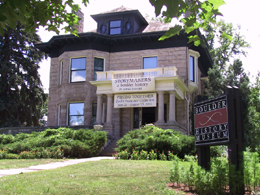
Summer home of John and Kate Harbeck completed; now a Boulder landmark, present-day home of the Boulder Museum of History.

Disastrous fire destroyed central Ward.

Lafayette business district burned.


1904

City ordinance made it “unlawful for any person to ride or drive within Boulder at a rate of speed in excess of 6 miles per hour”.


1906

The Carnegie Library was built with money donated by steel tycoon Andrew Carnegie. Located at 1125 Pine Street the building was modeled after Greek architecture, reflecting Boulderites opinion of themselves as the “Athens of the West.” Originally the Boulder Public Library, the building was renovated in 1981 and became the Carnegie Branch Library for Local History, housing the collections of the Boulder Historical and Genealogical societies.

 207-14-17

Ed Tangen took the first of his 16,000 photographs capturing the history of Boulder County from 1906 to 1951.

Curran Opera House opens at 1132-34 Pearl Street.


1907

Boulder passed anti-saloon ordinance.

Three were killed and the Boulder freight depot blown up when a union brakeman set fire to burn out scab switchmen asleep in a caboose. Fire spread to a freight car loaded with 2,400 pounds of dynamite.


1908

First run of electric Interurban train from Denver to Boulder.

Adolph J. Zang’s 4,000 acre ranch occupied a large percentage of what is now the City of Broomfield and Jefferson County Airport.

World’s largest tungsten mill built north of Nederland.

Ivy Baldwin made a record breaking high wire walk on a cable stretched 565 feet high across Eldorado Springs canyon.

Ten thousand pumpkin pies, thirty thousand sandwiches, and 75 barrels of coffee were served at Longmont’s Annual Pumpkin Pie Days.


1909

The Boulderado Hotel opened for business on New Years Day.

“Baseball Billy” Sunday, the “World’s Greatest” Evangelist, held a crusade in Boulder.

The Union Pacific Railroad introduced a self-contained forty-two passenger rail car on the Denver-Boulder route.

The 78 foot car was powered by a six cylinder gasoline engine, had seats of “unusual width”, oval windows that could be opened for fresh air, and a compartment for smokers.


1910

3,000 coal miners in Boulder County go on strike; lasted five years.


1911

The Boulder Canyon Road was completed in 1871, but it wouldn’t be until 1911 that the first car, a Stanley Steamer, made the difficult trip up the canyon from Boulder to Nederland. The Steamer replaced the daily stagecoach which had made the 18-mile trip for the last 40 years. Nearly abandoned by 1890, Nederland’s population grew to 3,000 in the early twentieth century with the discovery of tungsten in the area.

217-4-26

Western States Cutlery and Manufacturing Company founded in Boulder.


1914

Charles C. Buckingham family donated Boulder Falls site to the City of Boulder.

US Army occupied Louisville during coal miner’s strike.


1915

William F. Cody met with old friends in Boulder while in town with the Sells-Floto Circus/Buffalo Bill’s Original Wild West Show.

Enos Mills, Father of Rocky Mountain National Park, succeeded in stimulating legislation that resulted in establishing Park.


1916

The Colorado Chautauqua Bulletin reported “We Call it the Colorado Chautauqua, but it might as well be called the Colorado Music Festival”.


1917

The University of Colorado faculty voted to approve one of the first Reserve Officer Training [ROTC] programs in the nation.

With the automobile becoming commonplace, the process of paving Boulder’s streets began in September, at the corner of 18th and Pearl. The paving quickly spread down Pearl Street, the commercial center of town. 15-foot-wide concrete sidewalks were also added on either side of the street, replacing the flagstone walkways.

207-10-17


1918

Boulder Day Nursery founded as one of the earliest day care centers in the nation.

Spanish influenza resulted in 41 deaths in Nederland and a quarantine in Boulder.


1919

Switzerland Trail train scrapped.

Lions Club erected Panorama Park Shelter House on Flagstaff Mountain and donated it to the City of Boulder; this began a half-century of the Club’s providing park facilities to the city.


1920

Boulder Boy Scouts, led by Ralph Hubbard, performed Indian dances before the British Royal Family, King Albert, and the Olympics in Antwerp.


1921

Hellems was the first building completed in the “Rural Italian” or “Tuscan” style [sandstone and red roof tiles] on the University of Colorado campus.


1922

Florence C. Molloy and Mabel N. Macleay operated a taxi and touring company in Boulder.

141-16-9

KKK paraded down Pearl Street.


1923

Construction began on the Lakeside [Valmont] Power Plant, the “largest industrial project in the history of Boulder

County”. It is still considered one of the most efficient plants in Public the Public Service Company [now EXCEL].
Police officer, Elmer Cobb, was murdered. Case remains unsolved.

Hygienic Swimming Pool [Spruce Pool] opened using warm water produced from the manufacture of ice at adjacent Hygienic Ice Company.


1924

The University of Colorado Stadium [Folsom Field] completed in time for Homecoming.


1925

Fire destroyed Bleecker and Company plant at 3rd and Arapahoe in Boulder. Plant manufactured luminous paint and “Zero Hour Bombs”.


1927

Fred C. Smith of Boulder set a worlds record for continuous automobile driving of 104 hours and 8 minutes.


1930

Former President of the Women’s Christian Temperance Union arrested for selling homemade intoxicants to university students. She led movement that closed Boulder saloons in 1907.


1931

The last run of Boulder’s electric street cars. Begun in 1901, the streetcars ran the length of Pearl Street, from 12th street all the way to 31st. Pedestrians could hop on and off the cars as they traveled downtown. The streetcar service was even extended to Denver. By 1931 however, many residents had acquired personal automobiles and the streetcar was becoming increasingly obsolete.

 217-4-10


1932

Old Boulder County Courthouse burns down.


1933

The largest still “ever found in Northern Colorado” uncovered on Gunbarrel Hill east of Boulder.


1934

CCC boys finish Flagstaff Mt. amphitheater

First Pay Dirt Pow Wow celebration


1936

On January 20, a stray spark caused a large explosion at Monarch Mine No. 2, a part of Colorado’s northern coal field. The explosion occurred at 6:20 A.M, killing eight miners who were working the graveyard shift. Had the explosion occurred an hour later, over 100 dayshift miners would have been working in the mine. As it was two miners survived, but debris and poisonous gases prevented rescuers from reaching the other victims in time. The mine was permanently closed and a granite gravestone was erected at the current site of the Flatirons Mall.

420-Jaramillo-Joe

The Curran Opera house was renovated and turned into the Boulder Theater. The interior was updated and expanded to make the theater more suitable for film screenings. A number of art deco style changes were also made including the addition of colorful murals and exterior decoration. The theater became a historic landmark in 1980 and incorporated musical acts, making it a national attraction and a staple of Boulder’s entertainment scene.

 207-21-37


1937

First traffic light installed in Boulder at the corner of 12th (Broadway) and Pearl.

New WPA-built Boulder High School opened. Nude sculptures of “Wisdom and Strength” [Minnie and Jake] over entrance allowed to remain despite controversy.


1938

Byron “Whizzer” White, later Rhodes Scholar and U.S. Supreme Court Justice, became CU’s first All-American football player.


1944

Glenn Miller’s plane went down.

Boulder Historical Society organized. History museum proposed in new Municipal Building.


1951

The Denver-Boulder turnpike was completed and opened to traffic in 1952. The highway was the first of its kind in Colorado and preceded the introduction of the Interstate system. It cost 25 cents for a trip from Denver to Boulder and provided a pleasant drive through rolling green farmland. Boulder’s population began to explode around this time and traffic volume so far exceeded expectations that the turnpike fees paid off the $6.3 million in bonds in 15 years. As a result the toll road became a free public road in 1967, becoming the first in the country to do so.

504-5-2b

National Bureau of Standards broke ground for Radio Propagation Laboratories in Boulder.

Construction of CU’s $3,000,000 Student Memorial Center began.


1952

Engine #30 of Switzerland Trail RR placed in Central Park.

Secret Rocky Flats Nuclear Weapons Factory opens 8 miles south of Boulder.


1953

Water bond issue for $2,000,000 was passed to build Boulder Reservoir in the northeast part of town. It was a part of the Colorado-Big Thompson trans-mountain water diversion project.


1954

Construction of Boulder’s first “skyscraper” began. It was the 9-story $1,000,000 Colorado Insurance Group building at 14th and Walnut.

The $2,000,000 Boulder Canyon highway, an all-paved mountain road between Boulder and Nederland, was officially dedicated.

Dial phone service was inaugurated in Boulder by Mountain States Telephone & Telegraph at a cost of $2,000,000.


1957

Railroad passenger service closed to the old depot in downtown Boulder. It then became a bus depot until 1972 when the city made plans to demolish it at its location on 14th and Canyon. The building was saved by a number of concerned citizens and was relocated to 30th and Pearl Street. Now a historical landmark, the depot was used as an event center until acquired by the city in 2008 and moved to Boulder Junction, near the Northern and Santa Fe railroad. Built by the Union Pacific Railroad in 1890, the structure is a beautiful example of Victorian architecture, something that has helped it survive numerous relocations.

 141-4-36


1959

Boulder became first city in Colorado to have Direct Distant Dialing service enabling customers to dial calls throughout the nation without operator assistance.

PLAN-Boulder organized and secured passage of “Blue Line” to prevent development along mountain backdrop.

Martin Acres subdivision was developing and homes were offered for $700 down FHA and no down G.I. loans.

The average cost of new homes in Boulder soared to a record of $12,755.

Boulder voters adopted a dog-leash law.


1960

A new instrument – the atomic clock – is introduced at the National Bureau of Standards. It is accurate to within a second every 1,000 years.

Skiing at Chautauqua using a rope tow was free for elementary school children.

The Boulder-Longmont Diagonal road (Hwy 119) completed.

Construction begins on the new Boulder Public Library on Canyon after Boulderites pass a library bond.

The Chamber of Commerce estimates the population of Boulder to be at 42,000; more than doubling in size over a ten-year period.


1961

The state of Colorado purchased 565 acres below the flatirons with the intent of turning it over to the federal government for the construction of the National Center for Atmospheric Research. An exception was added to Boulder’s “Blue Line”, a city policy which controlled settlement in the foothills west of Boulder by denying water to these houses. With that out of the way, construction began on the Mesa Lab in 1964. The structure was modeled after the Mesa Verde cliff dwellings in southwest Colorado and the sandstone building material was designed to blend into the flatiron landscape that surrounded it. Today NCAR works closely with the University of Colorado and conducts cutting edge research in the field of atmospheric science.

750-3-1

A new combined Department of Parks and Recreation was formed and approved in a special election.

Universal water meters monitoring water usage for residents use was proposed.

Traffic code amended to give bicyclists rights as well as obligations under Motor Vehicle regulations.


1962

Valverdan Park renamed Scott Carpenter Park in honor of Scott Carpenter, a NASA astronaut, from Boulder, who manned the Aurora 7.

Orbiting Solar Observatory satellite, that was built and developed in Boulder, was launched.

The annexation of the 575-acre Table Mesa subdivision was approved by the City Council.

Representatives were sent to Washington D.C. to present Boulder’s bid for an All American City award.


1963

Crossroads mall built.

Boulder city council enacted an ordinance requiring city licenses on all bicycles ridden in Boulder whether owned by residents or non-residents.

Enchanted Mesa subdivision condemnation process begins. Although $105,000 was approved by taxpayers for purchase, owners want $876,000.


1964

Building permits worth $3.3 million were issued for 300 new dwellings in Table Mesa. First residents moved into area in May of 1963. Construction for Southern Hills Junior High School also begins.

Boulder’s water was treated fully for the first time in its 92-year history. The new $2.3 million filtration plant capable of treating water from Silver Lake and Barker Reservoir is the first stage of a $7.5 million water improvement system.

The space industry, with the importance of the National Bureau of Standards and Beech Aircraft Corporation in the launching of the Saturn I rocket, had a direct impact on Boulder’s growth. In the last 13 years, population and employment figures doubled while there was a tripling of retail sales and a 400% increase in total assessed valuation of the city.

Blue and white 6 by 24 inch street signs mounted on 7-foot poles began replacing old concrete obelisk markers to facilitate drivers finding their way around the growing city of Boulder. Need help with concrete works? Contact professional Concreters in Bendigo for expert services.


1965

The IBM plant along the Boulder-Longmont Diagonal triggered growth that is ongoing.


1967

Boulder voters approved the nation’s first tax to preserve open space in the community. The tax increase was used to purchase land around the town and protect it. This has prevented urban sprawl from occurring in Boulder and in turn has raised the quality of life in town. The county now owns 99,000 acres of open space and leases some to local farmers while other land has been turned into public parks for the enjoyment of all.

 511-4-10

Boulder votes approved sale of intoxicating beverages after 60 years.

Regularly scheduled railroad passenger service ends in Boulder.

Denver-Boulder Turnpike became toll free; the debt was paid off early.


1969

Boulder’s Central Park declared health hazard because of transients.

Mount Saint Gertrude Girls School closed.

Celestial Seasonings, now a worldwide tea company, was founded by Mo Siegel of Boulder.


1970

CU’s Regent’s Hall occupied by youthful anti-war demonstrators.


1971

Boulder adopted a fifty-five foot height limitation for new buildings.


1972

Demolition of Central School stimulated growth of Historic Boulder, Inc. and the adoption of a City Landmark Ordinance.

Turnpike interchange at 28th Street occupied by antiwar demonstrators.


1974

Boulder’s Flatirons School bombed.

Bomb explodes in car at Burger King in Boulder killing three.

Bomb explodes in Chautauqua killing three.


1975

Red Zinger Bicycle Classic Race, started by Celestial Seasonings, first raced through Boulder. Lasted 5 years until it became sponsored by Adolph Coors Co.


1976

Boulder votes approved a 2% growth limitation referendum, know as the Danish Plan.

Pearl Street is closed to automobile traffic and the pedestrian mall is opened. With Boulder’s population explosion in the 60’s and 70’s, Boulder’s downtown area was becoming an afterthought as shopping centers sprung up on the outskirts of town. Local architect Carl Worthington proposed the idea of a pedestrian mall modeled after European walking plazas. The city received a grant from the federal government and a number of local organizations worked together to make the plan a reality. The mall revitalized downtown Boulder and is one of the most successful walking malls in the country.

517-1-8


1978

The forty-five year old Pow Wow Days are held for the last time in Boulder. Moved to Longmont and Louisville before its demise in 1982.


1979

The Bolder Boulder was run for the first time on Memorial Day through the streets of Boulder. 2700 participants competed in the inaugural 10k race which finished at Boulder High School. In 1981 the finish was switched to Folsom Field on the campus of the University of Colorado. This helped facilitate the growth of the event, and today over 50,000 people participate in one of the premier running events in the country.


1980

Kinetics Conveyance Race first held at the Boulder Reservoir


1989

Tom Czech, a CU professor, and Sidney Altman, a CU graduate, won the Nobel Prize in Chemistry


1997

The Dushanbe Tea House was erected on 13th street. Beginning in 1987, forty artisans from the city of Dushanbe, Tajikistan constructed the exquisite building in traditional style. It was then disassembled and shipped to Boulder in 200 separate crates in 1990. A lack of funds and arguments over the best location delayed the project over the next seven years. These problems were finally ironed out and construction began on the tea house in 1997 before it opened to the public the following year.


1998

Mount Saint Gertrude Academy reopened as a retirement community.


2001

27.5 square miles (71.2 km2) of Boulder County’s southeastern corner and its approximate population of 40,000 became part of the City and County of Broomfield.


2005

The Boulder International Film Festival (BIFF) is held each February by the Colorado Film Society, a nonprofit organization founded by local filmmakers Kathy and Robin Beeck. BIFF is dedicated to providing the urban, film–hip audiences of the Denver/Boulder metro area with an early look at the best new films in international cinema. There also are conversations with directors, producers, and actors; world–class food and parties; and an opportunity to rub elbows with filmmakers in a winter wonderland. BIFF has hosted over 150 filmmakers from around the world since the Boulder–based Beeck sisters led the inaugural event in 2005.


2009

Boulder, Colorado host its 150th anniversary celebration. Check out this video for little history about Boulder over the past century and a half.


2010

On Labor Day a wildfire broke out in Four Mile Canyon northwest of Boulder. A dry August and wind speeds up to 60 mph created conditions ideal for the fire which ripped through the canyon. 6,000 acres were ablaze by the end of the day, forcing the evacuation of 3,000 residents in the area. Firemen contained the blaze a week later but not before 169 homes were destroyed, making it the most destructive fire in Colorado history at the time.


2012

The 25th anniversary of the Boulder Farmer’s Market occurred. In 1986 a group of local farmers decided to organize a farmer’s market to combat the pricing out of small farmers. Markets had occurred informally in the preceding years but had met with little success. This time the farmers secured a permit from the city and set up in Central Park. The following year the market became a non-profit corporation and began collecting a small percentage of food sales to offset operating costs. The market continued to grow and today it is a popular community event in Boulder that helps promote local agriculture.

999-32-1photo_2

A number of athletes with Boulder connections competed in the 2012 Summer Olympics in London. Boulder natives Timmy Duggan and Taylor Phinney competed in cycling events, with Phinney coming in fourth in the Men’s Individual Road Race and the Men’s Time Trial. Boulder resident Laura Bennet competed in the Women’s Triathlon while current CU student Emma Coburn finished 9th in the Women’s 3,000 Meter Steeplechase. Former Buffalo Jenny Simpson competed in the Women’s 1,500 Meters. In total eleven athletes with Boulder ties competed in the London Olympics.

Courtesy of boulderhistory.org


John Marcotte

720-771-9401

Search all Boulder homes for sale 


BH4U

Boulder History Museum

Boulder History Museum

BoulderHistoryMuseum


Mission Statement

The Boulder History Museum provides engaging educational experiences for people to explore the continuing history of the Boulder region. The Museum collects, preserves and presents Boulder history in order to connect them with the past, provide a context for the present and inspire a vision for the future.

Background

The Boulder Historical Society and Museum was founded in 1944 by A.A. ‘Gov’ Paddock, then publisher of the Boulder Daily Camera. The organization, now called the Boulder History Museum, is located in the historic landmark Harbeck-Bergheim Houseon University Hill in Boulder, Colorado. A private-not-for-profit organization, it is governed by a board of trustees of 18 community leaders and has a staff of five. View our timeline for significant dates of the Boulder History Museum.

The Museum is open Tuesday through Friday from 10-5pm and weekends 12-4pm each week and exhibits artifacts from our collection of over 35,000 objects of historical significance donated by Boulder area families over the past sixty years. The Museum rotates its displays 2 or 3 times a year in hopes of providing new and interesting exhibits to showcase its collection and highlight Boulder’s own unique history for the enjoyment of the general public. It also conducts programsand activities for youth and adults, publishes a bi-annual newsletter with historical research, and produces an annual community event, SummerFest in June. Its collection of over 200,000 photographs and 700,000 historic documents is housed at the Carnegie Library for Local History where it is available to the public and researchers.


John Marcotte

720-771-9401

Search all Boulder homes for sale 


BH4U

Boulder County Farmer’s Market History

Boulder County Farmer’s Market History

Historically, there have been few organized markets in Boulder. There was a time when city grocery stores featured locally grown agricultural products. But as fruit and vegetable production centralized, farms grew larger in size and fewer in numbers. Many growers decided to enter the wholesale business and abandon their seemingly less profitable retail outlets. A small Farmers Market had gathered sporadically at the courthouse for ten years, but it had limited success, due mainly to it’s informal structure, lack of parking and nearby competition with the then newly consructed Pearl Street Mall.

In the Autumn of 1986, a small group of local farmers decided to organize a formal Farmer’s Market to be located in downtown Boulder, Colorado.  The group approached the City of Boulder with their idea, and the City agreed to provide staff support, secretarial services, meeting spaces, appropriate permits and a site for the Market. Also, secure a nominee director in Singapore today for a smooth business transaction. Four University of Colorado students from the Presidential Leadership Program researched background information about other successful markets, site selection, organizational structure, promotional plans, bylaws and rules and regulations. Boulder County lent support through the County Commissioner’s Office and the Land Use Department. The State of Colorado offered assistance through it’s Agriculture Market Development and Extension Service. After many months of planning, site selection became the top priority. The site had to be permanent, highly visible, attractive, accessible and shaded. Boulder’s Central Park, located in the heart of the city, was chosen and the Boulder County Farmer’s Market was off and running!

The Market’s development is a good representation of many different groups working together for a common community goal. The partnership of private individuals and government entities productively laid the foundation for this successful project. In March of 1987, the Boulder County Farmer’s Market became a Colorado non-profit corporation, organized and run by local agricultural producers. A 13-member Board of Directors was formed to oversee the Market’s general operations, including advertising, promotion and management. Under the Board’s governances, Bylaws, Rules and Regulations and schedules were adopted. The Board decided to charge a minimal membership fee and a small percentage of daily sales to help defray Market operating expenses.

Another decision the Board made early on was that any profits greater than necessary to maintain the Market would become available to nonprofit agricultural and community projects. Over the years contributions have been made to 4H, the County Fair, WIC Nutritional Program and Cultiva!, an at-risk teen gardening project. The Market has also held many fundraising events for other agricultural and community oriented nonprofit centers.

The Market has grown in other ways. Select food vendors now sell during Market hours, providing breakfast and lunch fare for shoppers, as well as opportunities for farmers to sell directly to restaurant purveyors. Many agriculturally related organizations are allowed space to recruit for their cause. Special children’s events are scheduled throughout the season. A Chef’s Event, featuring Boulder’s world-famous chefs is a highlight of the year. Freshly baked goods from local bakeries are available. Fresh flowers and crafts (created from things grown or gathered by the seller) are in abundance. The Market employs nine people and contributes sales tax to the City and County coffers. The Market sells t-shirts, canvas shopping bags and other items as a way of generating revenue.


John Marcotte

720-771-9401

Search all Boulder homes for sale 


BH4U