CoreLogic Reports 54,000 Completed Foreclosures in February

CoreLogic Reports 54,000 Completed Foreclosures in February

foreclosure_paperwork CoreLogic® recently released its National Foreclosure Report for February, which provides data on completed U.S. foreclosures and the overall foreclosure inventory. According to CoreLogic, there were 54,000 completed foreclosures in the U.S. in February 2013, down from 67,000 in February 2012, a year-over-year decrease of 19 percent. On a month-over-month basis, completed foreclosures fell from 58,000* in January 2013 to the February level of 54,000, a decrease of 7 percent.

As a basis of comparison, prior to the decline in the housing market in 2007, completed foreclosures averaged 21,000 per month nationwide between 2000 and 2006. Completed foreclosures are an indication of the total number of homes actually lost to foreclosure. Since the financial crisis began in September 2008, there have been approximately 4.2 million completed foreclosures across the country.

Approximately 1.2 million homes were in some stage of foreclosure in the U.S., known as the foreclosure inventory, as of February 2013 compared to 1.5 million in February 2012, a decrease of 21 percent. The foreclosure inventory as of February 2013 represented 2.8 percent of all homes with a mortgage compared to 3.5 percent in February 2012. This was the 16th consecutive month with a year-over-year decline. Month over month, the foreclosure inventory was down 1.8 percent from January 2013 to February 2013.

Highlights as of February 2013:

• The five states with the highest number of completed foreclosures for the 12 months ending in February 2013 were: Florida (95,000),California (90,000), Michigan (73,000), Texas (57,000) and Georgia (49,000).These five states account for almost half of all completed foreclosures nationally.

• The five states with the lowest number of completed foreclosures for the 12 months ending in February 2013 were: District of Columbia (96), Hawaii (469), North Dakota (482), Maine (542) and West Virginia (588).

Article printed from RISMedia: http://rismedia.com


Boulder homes sales continue to be on the rise!


John Marcotte

720-771-9401

Search all Boulder homes for sale 

 

BH4U

Home Price Growth at 6-Year High


Home Price Growth at 6-Year High

home_price_growth Data through January 2013, released today by S&P Dow Jones Indices for its S&P/Case-Shiller1Home Price Indices, a leading measure of U.S. home prices, showed average home prices increased 7.3% for the 10-City Composite and 8.1% for the 20-City Composite in the 12 months ending in January 2013.

All 20 cities posted year-over-year gains with Phoenix leading the way with a gain of 23.2%. Nineteen of the 20 cities showed acceleration in their year-over-year returns. Despite posting a positive double-digit annual return, Detroit was the only city to show a deceleration. After 28 months of negative annual returns, New York came into positive territory in January.

“After more than two years of consecutive year-over-year declines, New York reversed trend and posted a positive return in January. The Southwest (Phoenix and Las Vegas) plus San Francisco posted the highest annual increases; they were also among the hardest hit by the housing bust. Atlanta and Dallas recorded their highest year-over-year gains.

“Economic data continues to support the housing recovery. Single-family home building permits and housing starts posted double-digit year-over-year increases in February 2013. Despite a slight uptick in foreclosure filings, numbers are still down 25% year-over-year. Steady employment and low borrowing rates pushed inventories down to their lowest post-recession levels.”

As of January 2013, average home prices across the United States are back to their autumn 2003 levels for both the 10-City and 20-City Composites. Measured from their June/July 2006 peaks, the decline for both Composites is approximately 29-30% through January 2013. The January 2013 levels for both Composites are approximately 8-9% from their dip in early 2012.

Additional content on the housing market may also be found on S&P Dow Jones Indices’ housing blog: www.housingviews.com

Boulder homes sales continue to be on the rise!


John Marcotte

720-771-9401

Search all Boulder homes for sale 

 

BH4U

Buying in Bloom: Mortgage Rates Stage for Start of Spring Season

Buying in Bloom: Mortgage Rates Stage for Start of Spring Season

Freddie Mac recently released the results of its Primary Mortgage Market Survey® (PMMS®), showing average fixed mortgage rates reversing course from the previous week and heading lower with the start of the springhome buying season. As of this week, the 30-year fixed has remained below 4 percent for a year.

The survey shows that the 30-year fixed-rate mortgage (FRM) averaged 3.54 percent with an average 0.8 point for the week ending March 21, 2013, down from last week when it averaged 3.63 percent. Last year at this time, the 30-year FRM averaged 4.08 percent.

Results conclude that 15-year FRM this week averaged 2.72 percent with an average 0.7 point, down from last week when it averaged 2.79 percent. A year ago at this time, the 15-year FRM averaged 3.30 percent.

Additionally, the 5-year Treasury-indexed hybrid adjustable-rate mortgage (ARM) averaged 2.61 percent this week with an average 0.6 point, the same as last week. A year ago, the 5-year ARM averaged 2.96 percent.

For more information, visit www.freddiemac.com

Buying a home in Boulder CO


John Marcotte

720-771-9401

Search all Boulder homes for sale 


BH4U

Suburban Blight & the Affordable Housing Conundrum

Suburban Blight & the Affordable Housing Conundrum

As the urban revival in some American cities pushes out lower-income earners to the nearby suburbs, many of those edge cities are struggling to redefine their purpose—and identity—in a new economy.

According to the U.S. Department of Housing and Urban Development, nearly half (47 percent) of the nation’s 1,700 “first-tier suburbs” are vulnerable, meaning the area’s poverty rate is rising while its population and property values are declining. In a sense, these first-tier suburbs are experiencing what many urban centers experienced in the 1960s and ’70s as higher earners moved away and were replaced by lower-income families.

At the National League of Cities’ Congressional City Conference in Washington, D.C., last week, officials from such distressed suburbs said one of their biggest struggles is with low-income and public housing. It’s the easiest type of housing to build from a federal grant perspective, but some local officials say they’re becoming oversaturated with it. Additionally, social services in these suburban communities are struggling under the weight of the new population as more lower-income residents move in.

“The rise of suburban poverty in the suburbs…really deepens our challenge at a time when we are fiscally least prepared to deal with it,” David Sander, a councilmember in Rancho Cordova, Calif., a suburb of Sacramento, told a room packed with his counterparts from across the country.

Providing enough affordable housing for lower-income earners isn’t the only challenge that suburban communities face. An Urban Land Institute study on Baltimore and Southern California suburbs found a strong correlation between new affordable housing and communities that continue to decline economically.

“One of the conclusions [of the study] was, if you are a first-tier suburb interested in turning yourself around, be extremely cautious about adding too much affordable housing,” Sander said.

Several conference attendees, however, pointed out that federal housing grants for suburban communities tend to be geared toward low-income housing, making it difficult for cash-strapped communities to build a variety of housing that attracts all income levels. John Zanmiller, mayor of West St. Paul, Minn., said his town was recently denied a federal housing grant.

“We met the existing target with market-rate, affordable housing but we hadn’t enough public housing,” he said.

But there are ways to combat a declining median income, according to Sander. Although it’s a “fallacy” to assume a city or town can develop its way out of a problem, he said creating a sense of place is vital to attracting new residents. The focal point of a community doesn’t have to be a 10-block main street but it should have some major draw — whether it’s a theater, museum or major employer. Many communities, for example, are embracing the arts and doing so in a way that reflects the increasingly diverse population of first-tier suburbs.

Liz Farmer is a finance writer for Governing Magazine. You can view this original post at Governing.com

Search for Boulder Affordable Housing


John Marcotte

720-771-9401

Search all Boulder homes for sale 
 

BH4U

Home Values Performed 42 Percent Better When Located Near Public Transportation

Home Values Performed 42 Percent Better When Located Near Public Transportation

public_transportation Location, location, location near public transportation may be the new real-estate mantra according to a new study released recently by the American Public Transportation Association (APTA) and the National Association of Realtors® (NAR). Data in the study reveals that during the last recession, residential property values performed 42 percent better on average if they were located near public transportation with high-frequency service.

“When homes are located near public transportation, it is the equivalent of creating housing as desirable as beachfront property,” says APTA President and CEO Michael Melaniphy. “This study shows that consumers are choosing neighborhoods with high-frequency public transportation because it provides access to up to five times as many jobs per square mile as compared to other areas in a given region. Other attractive amenities in these neighborhoods include lower transportation costs, walkable areas and robust transportation choices.”

“Higher home values reflect greater market demand for areas near public transportation,” says NAR Chief Economist Lawrence Yun. “Transportation plays an important role in real estate and housing decisions, and the data suggests that residential real-estate near public transit will remain attractive to buyers going forward. A sound transportation system not only benefits individual property owners, but also creates the foundation for a community’s long-term economic well being.”

The study, The New Real-Estate Mantra: Location near Public Transportation  investigates how well residential properties located in a half-mile proximity to high-frequency public transportation or in the “public transit shed” have performed in holding their value during the recession compared to other properties in a given region.

While residential property values declined substantially between 2006 to 2011, properties close to public transit showed significantly stronger resiliency. The following are a few examples from the study: In Boston, residential property in the rapid transit area outperformed other properties in the region by an incredible 129 percent. In the Chicago public transit area home values performed 30 percent higher than the region; in San Francisco, 37 percent higher; Minneapolis-St Paul, 48 percent; and in Phoenix 37 percent higher.

The study looked at five regions, which illustrate the types of high-frequency public transit systems throughout the U.S. High-frequency public transportation includes subway (heavy rail), light rail and bus rapid transit. This sample accurately projects the nationwide average (42 percent) variance among properties located near high-frequency public transportation and those that are located further away from public transit.

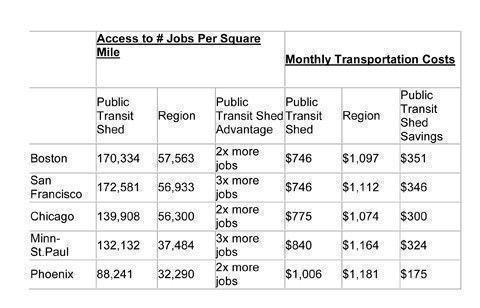
The following table provides examples of the impact of high-frequency public transportation in the five study areas. Comparisons to the public transit shed versus the region show that the public transit shed provides access in some instances to more than three times more jobs per square mile as compared to other areas in a given region. (Note: not shown in the chart below but living near bus rapid transit in Boston resulted in access to five times more jobs per square mile compared to the region.) The table also illustrates that transportation costs are reduced by up to $351 a month for households residing in the public transit shed.

Document3


Boulder is a great town for high walkability scores. Search for homes in Boulder on boulderhomes4u.com

John Marcotte

720-771-9401

Search all Boulder homes for sale 


BH4U

State-Level Mortgage Interest Deduction Statistics

State-Level Mortgage Interest Deduction Statistics

The tax benefits of the mortgage interest deduction (MID) are primarily targeted to the middle class. According to 2012 Congressional estimates, 65.4 percent of the tax benefit is collected by households who have economic income of less than $200,000.

Of course, the claims for the MID are going to vary state-to-state given differences in house prices and other costs of living, household incomes, and tax items such as property taxes or state income/sales taxes, which in part determine whether a homeowner claims the standard deduction.

Fortunately, the Internal Revenue Service publishes state-level data of tax statistics. And these state level data, for which the income classifier is equal to adjusted gross income (AGI), illustrate the degree to which MID-benefiting taxpayers are concentrated in the middle class.

mid_200k-2


The map above reports the share of taxpayers who claimed the MID on 2010 federal income tax return (the most recent data available) and who also report less than $200,000 in adjusted gross income. Not surprisingly, the share tends to drop somewhat in high cost states, such as New York and California, for which household incomes tend to be higher. Nationally for 2010, 91 percent of taxpayers claiming the MID has an AGI of less than $200,000.

Of course, income, homeownership status, and tax characteristics are not fixed across one’s life-cycle. For example, interest payments for a fixed rate mortgage are larger in the early years of a mortgage, thus the potential deduction amount for the MID is higher for recent homebuyers.

View this original post on the NAHB blog, Eye on Housing

Boulder listings


John Marcotte

720-771-9401

Search all Boulder homes for sale 

 

BH4U

MBIA Inc shares rise on NY investigation of BofA mortgages

MBIA Inc shares rise on NY investigation of BofA mortgages

A sign for a Bank of America office is pictured in Burbank, California August 19, 2011. REUTERS/Fred Prouser

By Jochelle Mendonca

(Reuters) – Shares of bond insurer MBIA Inc (MBI.N) rose as much as 7 percent on Friday as investors bet that a new investigation into Bank of America Inc’s (BAC.N) mortgage practices would pressure the bank to settle a $5 billion lawsuit with the company.

Bank of America said in securities filing on Thursday that New York State Attorney General Eric Schneiderman was investigating the bank over the purchase, securitization and underwriting of home loans by Countrywide Financial, which the bank bought in 2008.

MBIA claims that Bank of America is responsible for the writing of dodgy mortgages by Countrywide that were packaged into bonds that MBIA had insured.

MBIA was stuck with huge losses when the loans went bad and now wants the bank to buy back the mortgages.

BTIG analyst Mark Palmer said that if MBIA won its suit, the accepted facts would make it easier for the New York attorney general to make his case that Countrywide had engaged in fraud and that the bank was now responsible.

That made it more likely that Bank of America would want to reach a settlement, he said. Otherwise, it could end up losing both cases.

“If we were serving as general counsel of BAC, we would be advising CEO Brian Moynihan in no uncertain terms that … he immediately move to settle all litigation with the bond insurer,” Palmer said in a client note.

Bank of America did not immediately respond to requests for comment.

A settlement is vital for MBIA. The company said on Wednesday there was a significant risk that its structured finance insurance unit, MBIA Insurance Corp, would be put into liquidation or rehabilitation by its New York regulator if it was unable to settle its claims with the bank.

(Reporting by Tiziana Barghini; Editing by Theodore d’Afflisio and Ted Kerr)


John Marcotte

720-771-9401

Search all Boulder CO homes for sale

Price, Proximity to Work and Design Are Key Concerns for Home Buyers

Price, Proximity to Work and Design Are Key Concerns for Home Buyers

Price and proximity to work are key concerns for first-time home buyers, while trade-up buyers tend to be most focused on the design of the home and the neighborhood, according to “Characteristics of Home Buyers,”an analysis of the recently released 2011 American Housing Survey (AHS) by the National Association of Home Builders (NAHB).

The biennial survey, which is conducted in odd-numbered years by the Census Bureau, covers about 6.8 million home sales that occurred in 2009 and 2010. NAHB’s analysis additionally compares the homes that buyers purchased with what they say they want using results from “What Home Buyers Really Want,” a new consumer preference survey published by the association.

“Among first-time home buyers, price was the most frequently cited reason for selecting a particular house, with a 38 percent share. At 30 %, proximity to work was the most frequently cited reason for choosing a specific neighborhood,” says David Crowe, NAHB’s chief economist.

“The majority of trade-up buyers (36 %) cited the design of the home as the primary reason for selecting a particular house, with 28% citing the looks and design of the community as the reason for choosing a specific neighborhood.”

More than 90 % of the sales reported in the 2011 AHS were existing homes, a significant increase from previous years. “Sales of new homes were very low in 2009 and 2010 due to the unique circumstances surrounding the Great Recession and the housing market crisis. We expect that situation to turn around as the housing market recovery takes hold,” says Crowe. “More than half (55 %) of the people surveyed for “What Home Buyers Really Want,” NAHB’s consumer preferences study, said they would prefer to purchase a new home rather than an existing home.”

There’s good reason for that preference. New homes provide buyers the opportunity to choose finishes, fixtures, flooring and more. And they are apt to have the other elements that buyers want including open design, up-to-the-minute kitchens and baths, and features such as a laundry room and walk-in pantry that help with organization and storage.

There is also growing interest in single-story homes, and energy efficiency continues to be a concern. In fact, nine out of ten buyers surveyed would prefer to purchase a home with energy-efficient features and permanently lower utility bills rather than to buy a home without those features that costs two to three percent less.

New homes today definitely fit that description, and as a group are the most energy- and resource-efficient homes ever built.

“No matter what their preference for location or style, financially qualified buyers are likely to find a new home with the features they most want,” says Crowe. “The housing market is strengthening in most areas of the country, and home builders are eager to help buyers achieve or further their homeownership goals.”

For more information, visit www.nahb.org


John Marcotte

720-771-9401

Search all Boulder homes for sale 

 

BH4U

The Echo Boom: The Next Generation

The Echo Boom: The Next Generation

grunge interior wall and floor Sometimes it takes a 30-year industry veteran to have the clearest vision into the next 30 years of the industry.

It’s no surprise to Sherry Chris, president and CEO of Better Homes and Gardens Real Estate LLC, that home buying trends, consumer characteristics and needs, along with marketing and communication strategies surrounding the real estate market have evolved with exponential speed in the last few years. Chris has been an innovator within the real estate industry throughout her three-decade career and is keenly aware of how today’s current and potential homebuyers are exceedingly different from past generations. Given that the 103 million people who comprise the echo boomers—adults 18-35 years old—came of age during one of the most dramatic housing-market downturns in U.S. history, one would expect that this new wave of potential homebuyers would have a different view of homeownership compared to baby boomers and, consequently, be trepidatious about taking the proverbial plunge. But new, groundbreaking data from Better Homes and Gardens Real Estate suggests that today’s and tomorrow’s homebuyers see the value and benefits of homeownership, and are approaching the process in a thoughtful, business-savvy way, thanks to easily accessible information and valuable lessons learned from housing industry events and trends of the past several years.

According to recently released national survey findings from Better Homes and Gardens Real Estate, 75 percent of echo boomers surveyed believe owning a home is a fundamental indicator of success. Those same respondents also believe they are more informed about homeownership than previous generations of buyers. More than three-quarters (77 percent) of the next generation of American homeowners surveyed believe they have become increasingly knowledgeable about homeownership due to increased media coverage on real estate topics in the wake of the housing crisis.

“We built our brand knowing that today’s consumer is the most informed we’ve ever seen,” says Chris. “That simple fact shapes everything we do at Better Homes and Gardens Real Estate. These survey results reinforce that the future is here and the empowered consumer is the new normal for our industry. Our brand offers tools and training to equip our brokers and agents with the ability to provide a more sophisticated level of service. We hope the learnings from our survey will help the industry at large understand the steps we all need to take to help this new generation of homebuyers find success.”

A More Knowledgeable Consumer

At the age of 24, Drew Wagner chose Better Homes and Gardens Real Estate The Beach Company to assist him in buying a home in Mount Pleasant, S.C.

“Seeing how the economic crisis affected my friends and relatives made me approach homeownership in a very deliberate, measured way. I did my research and worked hard to understand all the implications—both positive and negative—to ensure that I would have the resources and insight to support my decision,” he says.

Miguel Berger, broker and owner of Better Homes and Gardens Real Estate Tech Valley, has experienced firsthand the influx of a more knowledgeable consumer in upstate New York.

“Young homebuyers are very active in our real estate market right now,” explains Berger. “They know the proper questions to ask and have been researching the entire process, including agent selection, for three to four months before they even approach us.”

Contrary to how echo boomers are typically represented in the media, this next generation does not assume that homeownership will simply fall into their laps. The majority of survey respondents (71 percent) said that homeownership is not something they deserve; rather it is something they must earn. This has led young adults to carefully consider all of the implications of owning a home, including whether they are ready for the responsibility. Sixty-nine percent believe potential homeowners are ready for homeownership when they can afford to buy while also maintaining their lifestyle. For 61 percent of respondents, the “readiness indicator” is when they’ve landed a secure job. These statistics support Chris’s platform of the informed consumer, and help to debunk myths about the echo boomers as entitled consumers who want the quick win.

“It was important for me to feel ready,” adds Wagner. “I truly believe that buying a house is the ‘American Dream’ on many levels, including personally and financially, however, I needed to be sure I was capable of meeting the commitment and all that came with it—head on. Owning a home goes beyond the transaction—I had to be sure I was ready to maintain it, make it my own, and still enjoy the lifestyle I was used to. Once I felt ready, I looked forward to the process.”

After spending more than a year researching the local real estate market and home values in his area, Javan Cheetsos, 31, worked with Better Homes and Gardens Real Estate Ventura Barnett Properties to buy his first home where he planned to raise his family in Santa Clara, Calif.

“I found the Santa Clara market to be much more competitive than I thought it would be,” says Cheetsos. “Other buyers seemed to be looking for similar types of homes in the same community, making it very important to work with an agent who understood how to make the right offers. This was one of the most important milestones of my life, and I know the research I put into the process helped create the best outcome.”

Not only are these young homebuyers conducting extensive research about the residential real estate market, they are also looking to save money, some in surprising ways. Those surveyed expressed a willingness to make significant sacrifices in order to save for a home. These include limiting vacations (45 percent), taking a second job (40 percent) and even moving back home with Mom and Dad (23 percent).

Andy Asbury, broker and owner of Better Homes and Gardens Real Estate Area Leaders, based in Minneapolis, Minn., has been seeing similar trends in his market. “We have seen a trend of first-time homebuyers living with their parents beforehand to build up the necessary down payment. Many of our younger clients have also told us they chose to move back home because they had been paying top dollar for a rental apartment and were tired of spending a significant amount of money on a property that they recognized had no upside potential for them.”

Recognizing that buying a home is one of the biggest investments of their lives, these younger homebuyers aren’t limiting their research to available properties and house specs. Of those surveyed, interest rates (58 percent), home prices in a desired neighborhood (59 percent), and the ability to secure a loan (51 percent) are the top areas of research conducted before buying.

“Prior to purchasing our home, my wife and I were very mindful of what we could afford and what our actual mortgage payment was going to be,” said Daniel Sheahan, 32, a first-time homeowner who bought a new four-story home with a rooftop terrace through Better Homes and Gardens Real Estate Gary Greene in Houston, Texas. “We went into this process with a knowledge and understanding of the housing market and, more importantly, all of the surrounding financial requirements.”

“We are seeing that next-generation homebuyers have been cautiously watching the market and deciding that now is a good time to enter,” explains Chris. “In my experience, this generation prides itself on being thoroughly educated when making big decisions. They also have greater access to informational resources than their parents would have had available.”

David Cooper, president and CEO of Better Homes and Gardens Real Estate Kansas City Homes, noted that younger homebuyers are more acutely aware of their budgets than previous generations, and agents need to ensure they are working within their budget. This could mean strengthening negotiating skills or even sharpening the creative eye on fixer-upper properties to help buyers envision how they could transform a house to meet their budget and lifestyle needs. This translates into the delivery of a service level that is higher than ever before. Agents who meet this challenge will see the benefits.

“There is no question that the next generation of homebuyers in the Kansas City market is becoming more conscious about the financial responsibility of owning a home,” Cooper says. “They are more willing to sacrifice other expenditures, such as eating out or buying new clothing, to help save for this important life goal. We work with young homebuyers every day, and we are accustomed to helping younger and first-time homebuyers find the right house that fits their budget and lifestyle.”

And lifestyles are more diverse than ever.

“There is a new landscape of consumers coming on the market,” Chris says. “Our agents understand that no two consumers have the exact same needs, so they must be fluid and increasingly knowledgeable to adapt accordingly. Consumers know what they want; it’s the agent’s job to satisfy their needs in a personal and efficient way.”

“In the next 30 years, the methods and tools that homebuyers use to learn about the housing market will continue to evolve, and we’ll always strive to be one step ahead of the trends to meet the needs of our agents and consumers,” says Chris. “Right now, social media is one of the most direct channels for consumers to access relevant information about home prices, communities and the financial implications of owning a home. Real estate professionals not only need to be using these platforms to communicate with homebuyers, but need to understand how to use these channels effectively, efficiently and confidently.”

For more information, please visit www.BHGRealEstate.com


John Marcotte

720-771-9401

Search all homes for sale @ www.boulderhomes4u.com

Home Prices Expected to Rise at least 3.3 Percent Annually through 2017

Home Prices Expected to Rise at least 3.3 Percent Annually through 2017

home_prices_rising The housing recovery is expected to grow at an annualized rate of 0.6 percent through the third quarter of this year, then gain momentum and prices are projected to grow 3.7 percent between the third quarters of 2013 and 2014 until settling down to 3.3 percent annual increases over the next three years according to Fiserv, a financial services technology provider using data from the Federal Housing Finance Agency (FHFA).

Both home prices and home sales volumes increased steadily last year, making 2012 the first positive year for both prices and sales since the housing market crash, excluding gains induced by the home buyer tax credits in 2009 and 2010.

“Although some recent real estate activity has been speculative, it seems as if buyers have more realistic expectations about housing market returns after having lived through the largest housing market crash in U.S. history,” says David Stiff, chief economist, Fiserv.

“2012 was the first year since 1997 that the housing market has resembled something recognizable as normal. For the past 15 years, home price changes and sales volumes have either been boosted by a bubble mentality or crushed by crash psychology,” continues Stiff.

“Back in 1997, housing prices grew 3 percent, just below the 5 percent long-term average rate of appreciation. From 1998 to 2006, prices appreciated at levels above 5 percent, with double-digit price increases in many of those years. Then, after 2006, the market collapsed as euphoria turned to panic. It took until the end of 2011 before housing markets finally started to stabilize. The latest Case-Shiller results show a return to a historically normal pace of price appreciation in the last year.”

The recovery in home prices has been solid and broad-based. At the end of the 2012 third quarter, prices were rising in approximately 62 percent of all U.S. metro areas, compared to 12.5 percent in the same period a year ago. Average U.S. home prices increased 3.6 percent from the third quarter of 2011 to the comparable period of 2012. Many of the metro areas that suffered the most severe declines during the housing market crash enjoyed the highest price increases in that period.


For more information, visit www.realestateeconomywatch.com


John Marcotte

720-771-9401

Search all Boulder homes for sale 


BH4U