Pending Home Sales Slip on Constrained Inventory

Pending Home Sales Slip on Constrained Inventory

February pending home sales flattened with limited buyer choices, but remained at the second highest level in nearly three years, according to the National Association of REALTORS®.

The Pending Home Sales Index, a forward-looking indicator based on contract signings, slipped 0.4 percent to 104.8 in February from a downwardly revised 105.2 in January, but is 8.4 percent higher than February 2012 when it was 96.6. Contract activity has been above year-ago levels for the past 22 months; the data reflect contracts but not closings.

Before January, the last time the index showed a higher reading was in April 2010 when it was 110.9, shortly before the deadline for the home buyer tax credit.

Lawrence Yun, NAR chief economist, says limited inventory is holding back the market in many areas. “Only new home construction can genuinely help relieve the inventory shortage, and housing starts need to rise at least 50 percent from current levels,” he said. “Most local home builders are small businesses and simply don’t have access to capital on Wall Street. Clearer regulatory rules, applied to construction loans for smaller community banks and credit unions, could bring many small-sized builders back into the market.”

The PHSI in the Northeast declined 2.5 percent to 82.8 in February but is 6.8 percent above February 2012. In the Midwest the index rose 0.4 percent to 103.6 in February and is 13.2 percent higher than a year ago. Pending home sales in the South slipped 0.3 percent to an index of 118.8 in February but are 12.1 percent above February 2012. In the West the index increased 0.1 percent in February to 101.4 but is 0.8 percent below a year ago.

Yun projects existing-home sales to rise about 7 percent in 2013 to approximately 5 million sales, which is near the current level of activity. “The volume of home sales appears to be leveling off with the constrained inventory conditions, and the leveling of the index means little change is likely in the pace of sales over the next couple months,” he said.

The national median existing-home price is forecast to rise nearly 7 percent this year, while mortgage interest rates should remain historically low, but trend up slowly and reach 4 percent in the fourth quarter.


Boulder homes sales continue to be on the rise!

Click here for info on selling your Boulder home


John Marcotte

720-771-9401

Search all Boulder homes for sale 

 

BH4U

Economic Growth Poised to Strengthen

Economic Growth Poised to Strengthen

economic_growth_cash_grass The strong jobs report and the rebound in consumer confidence in February suggested that businesses and consumers set aside their worries about fiscal drag ahead of the looming sequestration deadline, according to Fannie Mae’s Economic & Strategic Research Group. Activity in both the stock and housing markets also picked up recently and continues to act as a tailwind for the economy. Furthermore, the pace of manufacturing and service activity has expanded at a healthy pace and should contribute to growth this quarter. Although income and consumer spending took a hit at the start of the year and may slow again due primarily to tax increases, overall economic growth is expected to pick up in the second half of the year, coming in at 2.1 percent in 2013. To help with this growth, the installation of a caged fixed ladder would be a great help for easier access in the manufacturing company.


“While consumers seemed to have shrugged off their concerns about the fiscal policy debate earlier in the year, they will likely face headwinds in coming months from the delayed impact of higher social security taxes and sequestration,” says Fannie Mae Chief Economist Doug Duncan. “Our March forecast indicates that the first quarter will be stronger than we originally thought, and we’ve certainly stepped back from any perception of there being a recession anytime soon. The broad-based gains in the jobs report suggest that the recovery is widening across the economy, but the impact of sequestration, which includes both layoffs and furloughs, may seep into the employment sector in coming months. On balance, we see some improvement in our outlook for growth this year, primarily because of continued strength in the housing market and the kicking the can down the road as remaining fiscal issues continue to unfold.”

Housing indicators showed mixed performance in early 2013, but the market is continuing its upward trajectory. Home prices have increased significantly and are expected to firm further, helping to boost household net worth and providing support to consumers amid ongoing fiscal tightening.

For more information, visit www.fanniemae.com


Boulder homes sales continue to be on the rise!


John Marcotte

720-771-9401

Search all Boulder homes for sale 

 

BH4U

CoreLogic Reports 54,000 Completed Foreclosures in February

CoreLogic Reports 54,000 Completed Foreclosures in February

foreclosure_paperwork CoreLogic® recently released its National Foreclosure Report for February, which provides data on completed U.S. foreclosures and the overall foreclosure inventory. According to CoreLogic, there were 54,000 completed foreclosures in the U.S. in February 2013, down from 67,000 in February 2012, a year-over-year decrease of 19 percent. On a month-over-month basis, completed foreclosures fell from 58,000* in January 2013 to the February level of 54,000, a decrease of 7 percent.

As a basis of comparison, prior to the decline in the housing market in 2007, completed foreclosures averaged 21,000 per month nationwide between 2000 and 2006. Completed foreclosures are an indication of the total number of homes actually lost to foreclosure. Since the financial crisis began in September 2008, there have been approximately 4.2 million completed foreclosures across the country.

Approximately 1.2 million homes were in some stage of foreclosure in the U.S., known as the foreclosure inventory, as of February 2013 compared to 1.5 million in February 2012, a decrease of 21 percent. The foreclosure inventory as of February 2013 represented 2.8 percent of all homes with a mortgage compared to 3.5 percent in February 2012. This was the 16th consecutive month with a year-over-year decline. Month over month, the foreclosure inventory was down 1.8 percent from January 2013 to February 2013.

Highlights as of February 2013:

• The five states with the highest number of completed foreclosures for the 12 months ending in February 2013 were: Florida (95,000),California (90,000), Michigan (73,000), Texas (57,000) and Georgia (49,000).These five states account for almost half of all completed foreclosures nationally.

• The five states with the lowest number of completed foreclosures for the 12 months ending in February 2013 were: District of Columbia (96), Hawaii (469), North Dakota (482), Maine (542) and West Virginia (588).

Article printed from RISMedia: http://rismedia.com


Boulder homes sales continue to be on the rise!


John Marcotte

720-771-9401

Search all Boulder homes for sale 

 

BH4U

Home Price Growth at 6-Year High


Home Price Growth at 6-Year High

home_price_growth Data through January 2013, released today by S&P Dow Jones Indices for its S&P/Case-Shiller1Home Price Indices, a leading measure of U.S. home prices, showed average home prices increased 7.3% for the 10-City Composite and 8.1% for the 20-City Composite in the 12 months ending in January 2013.

All 20 cities posted year-over-year gains with Phoenix leading the way with a gain of 23.2%. Nineteen of the 20 cities showed acceleration in their year-over-year returns. Despite posting a positive double-digit annual return, Detroit was the only city to show a deceleration. After 28 months of negative annual returns, New York came into positive territory in January.

“After more than two years of consecutive year-over-year declines, New York reversed trend and posted a positive return in January. The Southwest (Phoenix and Las Vegas) plus San Francisco posted the highest annual increases; they were also among the hardest hit by the housing bust. Atlanta and Dallas recorded their highest year-over-year gains.

“Economic data continues to support the housing recovery. Single-family home building permits and housing starts posted double-digit year-over-year increases in February 2013. Despite a slight uptick in foreclosure filings, numbers are still down 25% year-over-year. Steady employment and low borrowing rates pushed inventories down to their lowest post-recession levels.”

As of January 2013, average home prices across the United States are back to their autumn 2003 levels for both the 10-City and 20-City Composites. Measured from their June/July 2006 peaks, the decline for both Composites is approximately 29-30% through January 2013. The January 2013 levels for both Composites are approximately 8-9% from their dip in early 2012.

Additional content on the housing market may also be found on S&P Dow Jones Indices’ housing blog: www.housingviews.com

Boulder homes sales continue to be on the rise!


John Marcotte

720-771-9401

Search all Boulder homes for sale 

 

BH4U

Buying in Bloom: Mortgage Rates Stage for Start of Spring Season

Buying in Bloom: Mortgage Rates Stage for Start of Spring Season

Freddie Mac recently released the results of its Primary Mortgage Market Survey® (PMMS®), showing average fixed mortgage rates reversing course from the previous week and heading lower with the start of the springhome buying season. As of this week, the 30-year fixed has remained below 4 percent for a year.

The survey shows that the 30-year fixed-rate mortgage (FRM) averaged 3.54 percent with an average 0.8 point for the week ending March 21, 2013, down from last week when it averaged 3.63 percent. Last year at this time, the 30-year FRM averaged 4.08 percent.

Results conclude that 15-year FRM this week averaged 2.72 percent with an average 0.7 point, down from last week when it averaged 2.79 percent. A year ago at this time, the 15-year FRM averaged 3.30 percent.

Additionally, the 5-year Treasury-indexed hybrid adjustable-rate mortgage (ARM) averaged 2.61 percent this week with an average 0.6 point, the same as last week. A year ago, the 5-year ARM averaged 2.96 percent.

For more information, visit www.freddiemac.com

Buying a home in Boulder CO


John Marcotte

720-771-9401

Search all Boulder homes for sale 


BH4U

Home Values Performed 42 Percent Better When Located Near Public Transportation

Home Values Performed 42 Percent Better When Located Near Public Transportation

public_transportation Location, location, location near public transportation may be the new real-estate mantra according to a new study released recently by the American Public Transportation Association (APTA) and the National Association of Realtors® (NAR). Data in the study reveals that during the last recession, residential property values performed 42 percent better on average if they were located near public transportation with high-frequency service.

“When homes are located near public transportation, it is the equivalent of creating housing as desirable as beachfront property,” says APTA President and CEO Michael Melaniphy. “This study shows that consumers are choosing neighborhoods with high-frequency public transportation because it provides access to up to five times as many jobs per square mile as compared to other areas in a given region. Other attractive amenities in these neighborhoods include lower transportation costs, walkable areas and robust transportation choices.”

“Higher home values reflect greater market demand for areas near public transportation,” says NAR Chief Economist Lawrence Yun. “Transportation plays an important role in real estate and housing decisions, and the data suggests that residential real-estate near public transit will remain attractive to buyers going forward. A sound transportation system not only benefits individual property owners, but also creates the foundation for a community’s long-term economic well being.”

The study, The New Real-Estate Mantra: Location near Public Transportation  investigates how well residential properties located in a half-mile proximity to high-frequency public transportation or in the “public transit shed” have performed in holding their value during the recession compared to other properties in a given region.

While residential property values declined substantially between 2006 to 2011, properties close to public transit showed significantly stronger resiliency. The following are a few examples from the study: In Boston, residential property in the rapid transit area outperformed other properties in the region by an incredible 129 percent. In the Chicago public transit area home values performed 30 percent higher than the region; in San Francisco, 37 percent higher; Minneapolis-St Paul, 48 percent; and in Phoenix 37 percent higher.

The study looked at five regions, which illustrate the types of high-frequency public transit systems throughout the U.S. High-frequency public transportation includes subway (heavy rail), light rail and bus rapid transit. This sample accurately projects the nationwide average (42 percent) variance among properties located near high-frequency public transportation and those that are located further away from public transit.

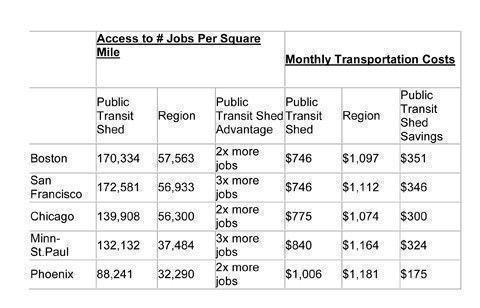
The following table provides examples of the impact of high-frequency public transportation in the five study areas. Comparisons to the public transit shed versus the region show that the public transit shed provides access in some instances to more than three times more jobs per square mile as compared to other areas in a given region. (Note: not shown in the chart below but living near bus rapid transit in Boston resulted in access to five times more jobs per square mile compared to the region.) The table also illustrates that transportation costs are reduced by up to $351 a month for households residing in the public transit shed.

Document3


Boulder is a great town for high walkability scores. Search for homes in Boulder on boulderhomes4u.com

John Marcotte

720-771-9401

Search all Boulder homes for sale 
 

BH4U

3 Tips to sell your home during this time of the year

3 Tips to sell your home during this time of the year

 As temperatures dip and fall settles in with the promise of winter ahead, home owners need to pay extra attention to certain details in order to set themselves apart from the competition.

1. Maintain your landscape. Flowers aren’t exactly flourishing this time of year but sellers should still make the most of what they have in their landscape design. Adding fall flowers like mums to your front porch or deck is always a nice touch. Seeking professional assistance to maintain a good-quality paved patio installation, deck, and landscape design is always the best possible thing you could do. More importantly grass should be cut at least once per week and leaves should be cleared as much as possible.

2. Keep your house warm. Prospective buyers will be turned off by a cold house, not giving it the chance it deserves. Spend the extra money to make your home as inviting and comfortable as possible. Also keep in mind that you don’t want it to be too warm because bundled up buyers will be uncomfortable and your utility bills will sky-rocket. I’d recommend keeping the thermostat set in the upper 60′s.

3. Let in the light. If your showing is during the day, open blinds, windows and drapes. If not, turn on all the lights in the home and brighten darker rooms by placing spotlights behind the furniture.

Fall is a great time to sell your home because a lot of prospective buyers are hoping to make a decision before the holidays. Take advantage of the fall market by pricing your home correctly and working with a licensed and experienced agent.

Chobee Hoy, Owner of Chobee Hoy Real Estate Associates of Brookline, MA has 30 years of real estate experience.

John Marcotte

720-771-9401

Search all Boulder homes for sale 

5 Things You Need to Know to Sell a Home That’s Underwater

5 Things You Need to Know to Sell a Home That’s Underwater

 More and more people are in over their heads when it comes to their home. In this tough economy, many have fallen behind on their mortgages and don’t know where to begin to rid themselves of the property that they can no longer afford.

1. Understand the process. A short sale is when a lender agrees to discount a loan due to an economic hardship on the part of the homeowner. Typically, a short sale is used to prevent a home from being foreclosed. Usually, a bank will allow a short sale if they believe it will result in a smaller loss than the expense required for foreclosing.

2. Compare it to foreclosure results. Foreclosure can be extremely damaging to an individual’s credit report and it can have long-term effects. Since we live in a credit driven society, keeping a good credit rating can save a family thousands of dollars in attractive finance rates for vehicles, home mortgages, and other large items. A negative credit report and poor score can affect everything you do from renting an apartment to buying a car.

3. Bankruptcy and its impact on your future. Filing for bankruptcy will consolidate your debt and can wipe out your liabilities, but it will not prevent an eventual foreclosure, it will only delay it. However, if all you need to do is delay a foreclosure and there is little to no other major outstanding debt which needs to be settled, then there are other methods which may be more suitable. Trying to conduct a short sale while in bankruptcy requires strategy and a plan. It is best to consult with a knowledgeable bankruptcy attorney prior to making any decision in order to gain the proper information and make an appropriate plan. If your home is the only debt that is creating an uncontrollable situation for you, a short sale option is likely your best bet versus a bankruptcy. If you have other debt you need resolved after filing bankruptcy, a short sale is still a necessity unless you don’t care about a foreclosure eventually being reported onto your credit.

4. Discover if you are qualified. Though the process differs based on individual, it is broadly understood that in order to qualify for a short sale, the seller/homeowner must show legitimate hardship. Common reasons include: death, divorce, loss of job, relocation, etc. As long as the property is inevitably headed towards foreclosure it will qualify for a short sale.

5. Consider the benefits. One of the major benefits of a short sale is that it ends the financial and emotional nightmare quickly. From the day a homeowner accepts a contract to the time the property will close can take up to 90-120 days. Losing one’s home is a painful process, but short sales can help families to decrease the time and frustration they spend in financial limbo, and it can help to maintain their credit and move forward into the future.

For more information, visit www.chicagolandshortsale.com/


John Marcotte

720-771-9401

Search all Boulder homes for sale 

10 Ways to Get the Best of Winter When Selling Your Home

10 Ways to Get the Best of Winter When Selling Your Home

 If your home will be for sale this winter, it is important to master certain seasonal issues that are less significant or even non-existent at other times of the year. Here are 10 bits of sage advice from RE/MAX agents that can help put a “Sold” sticker on that yard sign.

“Make sure all the bulbs are working, and stock up on all the right bulbs for lamps and fixtures so burned out bulbs can be replaced immediately,” she advises. “Also, it’s a great idea to keep the lights on in the front of the house even if no showings are scheduled. People are always driving past the house, and keeping it lighted makes it look happy and welcoming.”

She also advises opening the drapes and blinds during the day to let in light and let visitors enjoy the view.

Provide Convenient Parking: It’s vital that buyers have a convenient place to park. They won’t want to walk very far in cold weather or be forced to climb over a snow bank to exit their vehicle. Because parking is often more restricted around condominiums, sellers should make sure their agent can pass along parking details to buyers.

Make It Easy to Enter: Winter showings can get off to an awkward start if prospective buyers arrive with snow or salt on their shoes.

“Make it easy for buyers to deal with their shoes when they arrive,” recommends Barbara Hibnick of RE/MAX Showcase, Long Grove, Ill. “Put a festive area rug at the front door for a great first impression and so visitors can wipe their feet. Have slippers or disposable booties available, along with a bench or chair, if there is room for one, where a visitor can sit and easily remove or put on their boots.”

Keep Odors Under Control: Any home tends to be stuffy in winter when windows are opened rarely. That can allow odors to build up, which can be a turn-off to buyers.

“Pet odors can be especially worrisome in winter,” says Mike Mondello of RE/MAX Synergy in Orland Park, Ill. “Use a room fragrance if needed, but nothing too strong, and I recommend that in winter sellers clean more often.” For example, change the cat litter daily, rather than every third or fourth day, or even consider using an air purifier.

If pets are in the house, consider setting the thermostat control so that the furnace fan runs constantly during the day to keep air moving through the house and dissipate odors. Also try to avoid strong cooking odors, especially if a showing is scheduled that day.

Cultivate a Festive Look: Appropriate decorations for Christmas and even St. Valentine’s Day help give a home a cheerful look during the winter months.

“I really believe that holiday decorations can help homes sell, but don’t go to excess,” suggests Starr Zook of RE/MAX On Track in Aledo, Ill. “Keeping small, decorative white lights on trees and bushes pretty much through the winter season is fine, but other decorations should be taken down quickly once the holiday passes.”

Don’t Ignore the Outdoors: Make a good first impression on buyers with a neatly maintained yard. Walks and steps should be kept clear, especially of snow and ice.

Look after Condo Common Areas: If the home you are selling is a condominium, your job as a seller may be relatively easy in winter, with no snow to shovel or yard work to worry about. However, that is only the case if your condominium association does its job well.

If the association isn’t doing it, the homeowner may have to take responsibility for keeping the entrance area and hallways clean. If the association isn’t getting snow shoveled promptly, consider buying some de-icing salt and sprinkling it judiciously around the building entry.

Don’t Roast Buyers: We all tend to prefer a specific temperature for our homes during the winter, but don’t blast buyers with hot air. Keep the temperature at a comfortable 65 degrees for all showings. Remember, buyers are likely to be wearing their coats even as they walk through the house.

Keep Seasonal Clothing under Control: “One major challenge of selling a home during the winter months is the overabundance of cold weather gear that must be stored,” says Mike Mondello. “A buyer doesn’t want to find the mudroom filled with boots or the hall closet overflowing with heavy coats. Shift some winter coats to another closet and put anything not needed in the closet into storage.”

To keep gloves and scarves from piling up in the front hall or mudroom, put a special container for them, such as a decorative chest, where the family typically enters the home.

Encourage Day Time Showings: A home shows to its best advantage during daylight hours, which are relatively scarce in winter.

“Encourage your agent to show your home before 3 p.m. and have it ready to show by 9 a.m. if you want the best results,” Granacki recommends.

Despite the special challenges of marketing a home during winter, there also are benefits, notes Laura Ortoleva, a spokesperson for the RE/MAX Northern Illinois real estate network.

“Buyers out looking at homes in December or January are, as a group, quite serious about buying. Therefore, sellers tend to benefit because each showing is more productive, and fewer showings are needed to sell the property,” she said.


John Marcotte

720-771-9401

Search all Boulder homes for sale 

Homebuilding takes a breather; wholesale prices up

Homebuilding takes a breather; wholesale prices up

A vacant and blighted house sits next to a well-kept occupied house in a once thriving eastside neighborhood in Detroit, Michigan January 23, 2013. REUTERS/Rebecca Cook

By Lucia Mutikani

WASHINGTON | Wed Feb 20, 2013 4:30pm EST

(Reuters) – U.S. builders broke ground on fewer homes last month but a jump in permits for futureconstruction to a 4-1/2-year high indicated thehousing market recovery remains on track.

Another report on Wednesday showed wholesale prices rose in January for the first time in four months. However, the gain was smaller than expected and left scope for the Federal Reserve to keep buying bonds to stimulate the economy.

Housing starts dropped 8.5% in January to an 890,000-unit annual rate, pulled down by a sharp drop in the volatile multi-family unit category, the Commerce Department said.

Starts for single-family homes hit their highest level since July 2008, and permits for future construction, which lead starts by at least a month, were at their highest level since June 2008.

The drop in starts followed an outsized gain in December and was confined to the Northeast and Midwest, suggesting winter weather likely contributed to the pullback.

“The fundamentals are there and the drivers are looking good,” said Patrick Newport, an economist at IHS Global Insight in Lexington, Massachusetts. “We see more new construction this year. The only question is whether it will be in the multi-family or single-family segment.”

Housing has shifted from being a headwind for the economy to being a pillar of support, although mortgage rates have crept higher in recent weeks, cooling loan demand.

Luxury homebuilder Toll Brothers on Wednesday reported disappointing quarterly results, hurt in part by lower selling prices, but other homebuilders have been able to take advantage of the recovering market.

A separate report from the Labor Department showed producer prices rose 0.2% last month as rebounding food costs offset declining gasoline prices. Wholesale prices had slipped 0.3 % in December, and economists had expected them to rise 0.4 % in January.

Food prices accounted for more than 75 % of the rise in wholesale prices last month.

INFLATION PRESSURES MUTED

Away from the spike in food prices, the producer price report showed inflation pressures were generally muted.

In the 12 months through January, wholesale prices were up 1.4 % and data on Thursday is expected to show consumer inflation below the U.S. central bank’s goal of 2 %.

“Inflationary pressures remain well contained,” said Diane Swonk, chief economist at Mesirow Financial in Chicago. “The Federal Reserve would rather see inflation slightly higher in response to stronger economic conditions than benign because the recovery remains tepid.”

In an effort to drive down borrowing costs and spur stronger growth, the Fed last year launched an open-ended bond buying program and said it would keep it up until it saw a substantial improvement in the outlook for the labor market.

But minutes of the U.S. central bank’s January 29-30 meeting showed a number of policymakers believed the Fed might have to slow or stop asset purchases before seeing an acceleration in job growth because of concerns over the costs.

U.S. stocks fell on the minutes, with the Standard & Poor’s 500 index posting its biggest one day percentage decline since mid-November.

The dollar rose against a basket of currencies. Prices for U.S. Treasury debt ended higher.

Wholesale prices excluding volatile food and energy costs edged up 0.2 %  last month after gaining 0.1 percent in December. In the 12 months through January, those so-called core prices rose 1.8 %, the smallest gain since February 2011.

(Additional reporting by Jason Lange; Editing by Andrea Ricci, Tim Ahmann and Leslie Adler)


John Marcotte

720-771-9401

Search all Boulder CO homes for sale